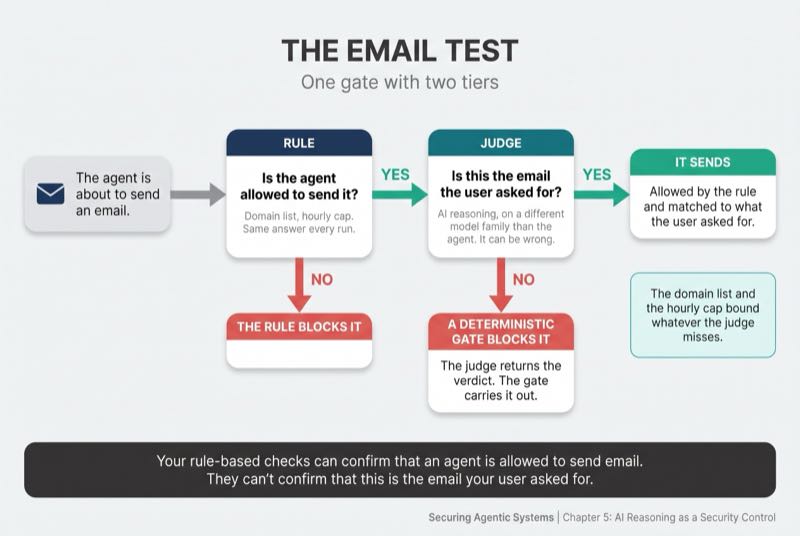
Your rule-based checks can confirm that an agent is allowed to send email. They can't confirm that this is the email your user asked for.
AI reasoning judges actions and artifacts against intent and policy, where rules can't decide. Intent is what the human asked for, policy is what the organization allows, and the artifacts are the designs and code the work produces.
Measure, the second step of the AI Security Posture Framework, scores how well each AI system your organization runs is protected. The framework is my five-step method for securing that AI, and this chapter opens Measure. The score looks for two types of security control in each system. One type is the deterministic, rule-based permissions, allowlists, and scanners you already use, which give the same answer every time they run. The other is AI reasoning, which can't promise the same answer twice. This chapter defines it as a control, because I haven't found a standard that does.
When I talk about AI reasoning, I usually mean a new security check in the software development lifecycle (SDLC). It takes the code and the threat model, the list of ways the system could be attacked, and finds vulnerabilities that traditional Static Application Security Testing (SAST) doesn't catch. I want the same judgment on a design before any code exists, and on an agent's action while it runs.
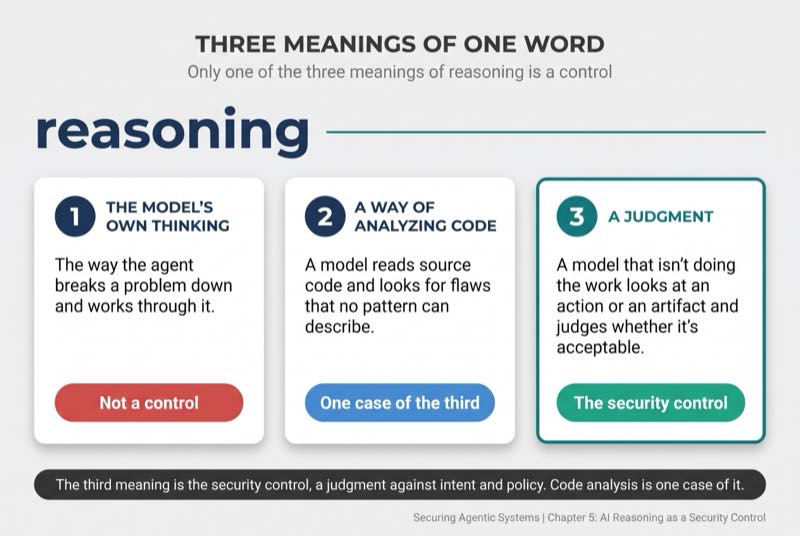
Three Meanings of One Word
Only one of the three meanings of "reasoning" is a control.
The first is the model's own thinking. Steve Wilson, writing on LLM security, uses the word this way when he names "reasoning models" as one reason coding agents improved so fast. That's something the agent does, the way it breaks a problem down and works through it.
Others use it for a way of analyzing code. A model reads source code and looks for flaws that no pattern can describe.
The third meaning is a judgment. A model that isn't doing the work looks at an action or an artifact and judges whether it's acceptable. Chris Hughes uses the industry's name for this, "LLM-as-a-Judge," meaning a large language model (LLM) set up to judge what an AI system does.
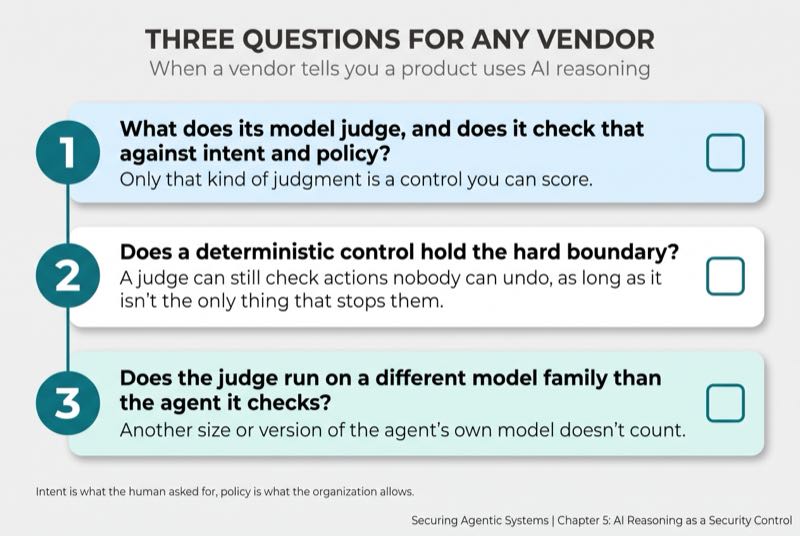
This book defines the third meaning. It also applies that judgment to designs and to code, so code analysis, the second meaning, becomes one case of the third. When a vendor tells you a product uses AI reasoning, ask what its model judges and whether it checks that against intent and policy. Only that kind of judgment is a control you can score.
AI reasoning, the control, is never the agent's own reasoning, and it doesn't even need to see the agent's thinking. Anthropic's auto mode for Claude Code, a setting that lets the coding agent run without asking a person to approve each action, hands approval decisions to what Anthropic calls a classifier. It is an LLM judge in Hughes's sense, a Claude model that judges each action before it runs. The company's engineers strip the agent's own messages and the results of the tools it ran from what that classifier reads, "making it reasoning-blind by design." They want it "to judge what the agent did, not what the agent said."
The Definition
AI reasoning is a security capability that uses an AI model to judge whether a design, code, or an agent's action matches intent and policy. It covers the decisions that rule-based checks can't make.
Use AI reasoning when a decision depends on meaning, context, or business logic that no rule captures. The email in the opening is that kind of decision. AI reasoning returns a finding or an allow-or-block decision. Either a deterministic gate or a person carries out that decision.
For a high-impact action that nobody can undo, a person needs to decide. That means actions like resetting a system, moving money, or deleting critical records. The people who design the system determine what is considered high impact, not an agent. Deterministic limits cap the damage. They set which domains the agent may email and how many messages it can send in an hour.
I use four nouns for AI reasoning in this book. Capability is what AI reasoning is, and a control is what you build with it at one point in the lifecycle. The mechanism is how it works (an AI model judging against intent and policy), and the point in the lifecycle is where it sits in your SDLC. The title says "as a Security Control" because that's how the capability gets used, and a control is what Measure scores.
Chapter 0, where I set out the framework, split every control into those two types. "Deterministic controls take every decision a rule can express," and AI reasoning takes the decisions rules cannot express. It catches "the case where the syntax is clean and the meaning is wrong," the code or the action that passes every rule and still does the wrong thing.
Guardrail is the broad word for any control around the AI. A hard boundary limits what an agent can reach or do. A soft guardrail inspects content and tries to catch the bad case, the malicious or unsafe input or action. Rule-based controls can be either kind. A permission is a hard boundary, and a code scanner is a soft guardrail. Chapter 0 also set the pairing rule. It pairs a hard boundary that always holds with an AI judge beside it for the decisions rules can't make.
The hard boundary is always deterministic, enforced outside the model's control, so nothing the agent says can argue its way past.
Chapter 0 gave the reason. "A judge that can be wrong has no business standing between an agent and an action nobody can undo." In plain words, a rule-based control, never an AI judge, is the one thing an agent can't talk its way past. A judge can still check those actions, as long as it isn't the only thing that stops them. The deterministic gate that carries out a judge's verdict doesn't count as that control, because the judge made the decision. The hard boundary is the limit that never asks the judge, like the email agent's domain list and hourly cap.
Hard boundary isn't my term. Chris Hughes contrasted it with soft guardrail in a March 2026 article on the blog of Zenity, a security vendor. He credits a piece by Idan Habler as the first place he saw the idea discussed for AI agents. Chapter 12 covers both kinds in full.
Where It Runs
The definition names three things to judge: a design, code, and an agent's action. Each one gets judged at a different time, design time, scan time, or run time, and I call those the three points in the lifecycle. It's one capability at all three. I don't call them stages, because the SDLC and the Agentic Development Lifecycle (ADLC), the development lifecycle my first book lays out, already have stages.
At design time, AI reasoning judges a design and lists the ways it could be attacked before the first commit. (My open-source threat modeling tool, tachi, works here.) Applying this definition at design time is my extension, a use no published study has tested yet. The published research behind this chapter verified the other two points in the lifecycle, scan time and run time, and the note on the figure below says the same.
Scan time covers code before release, whether a developer or a coding agent wrote it. Joshua Rogers, a security researcher, reviewed AI-based SAST tools in 2025. He wrote that beyond finding vulnerabilities, the biggest value he'd seen was in surfacing inconsistencies, including "mismatches between the developer intent and actual implementation, mismatches between business logic and reality."
SAST checks the code's structure. It matches known patterns and traces how data moves through the code, and it can't tell whether the code does what the business meant. SAST catches syntax, AI reasoning catches logic. A 2025 arXiv paper already describes a hybrid scanner that combines SAST with an LLM.
An AI finding can change from one run to the next, so record which model produced it and triage it the way you triage any scanner's output. SAST stays, along with the other deterministic scanners on the figure. Software Composition Analysis (SCA) checks your dependencies. Dynamic Application Security Testing (DAST) probes the running application, and Infrastructure-as-Code (IaC) scans check the files that define your environments.
The third point is run time, where the judgment applies to agent actions. Chapter 1 laid out one gate with two tiers. Deterministic checks run first, and judgment takes the cases a rule can't settle, such as whether a well-formed deletion is the one the user asked for. Chapter 12 builds that gate.
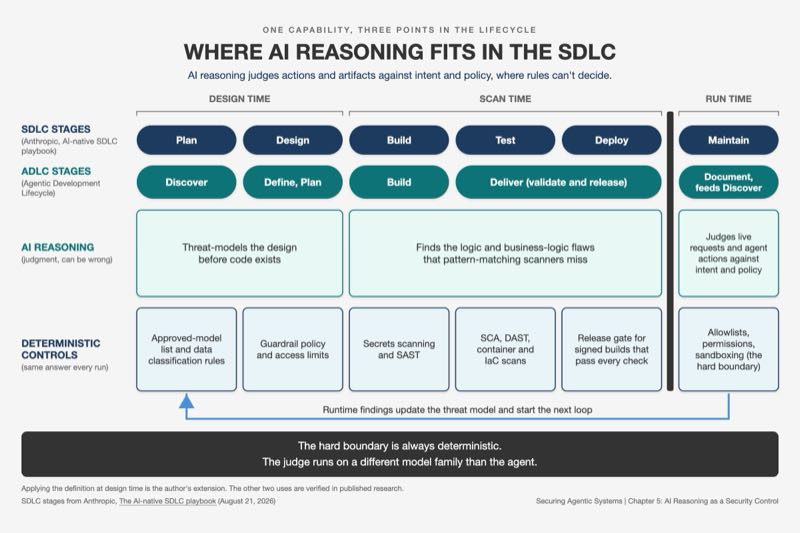
The figure's top row uses the six stages (Plan, Design, Build, Test, Deploy, Maintain) of Anthropic's AI-native SDLC playbook, a 2026 guide from the company. Under it sit the six stages of the ADLC, which are Discover, Define, Plan, Build, Deliver, and Document (see Chapter 7, Process Mastery, of my first book, Agentic-Oriented Development). The alignment is my analysis. Deploy and Deliver end at the release gate, the approval point where a build is allowed into production, and that gate separates scan time from run time. In the ADLC, I put the threat model at Plan and the scans at Build and Deliver. At run time, permissions, allowlists, and sandboxing, which runs the agent in an isolated environment it can't reach beyond, act on the agent's actions. Shift-left and shift-right tell you which way to move security work, earlier into development or later into production, and the three points tell you where the judgment runs.
No Standard Defines It
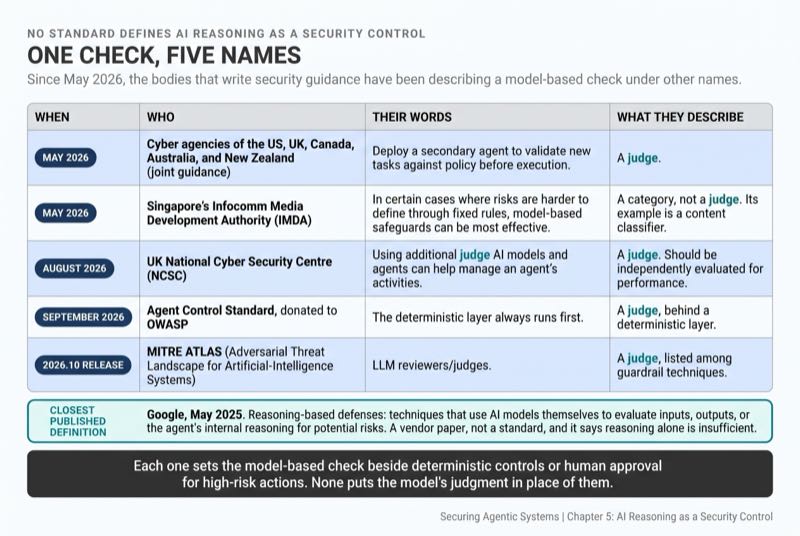
No standard or agency I've read defines AI reasoning as a security control. Since May 2026, though, the bodies that write security guidance have been describing a model-based check under other names.
Cyber agencies in the US, UK, Canada, Australia, and New Zealand published joint guidance in May 2026. One of its recommendations reads, "Deploy a secondary agent to validate new tasks against policy before execution." In August, the UK's National Cyber Security Centre (NCSC) wrote that using "additional ‘judge’ AI models and agents can help manage an agent's activities." It added that these judges "should be independently evaluated for performance."
MITRE's ATLAS (Adversarial Threat Landscape for Artificial-Intelligence Systems) is a public catalog of attacks on AI systems and their defenses, and it lists "LLM reviewers/judges" among its guardrail techniques. The Agent Control Standard, a specification for the controls around an agent, donated to the Open Worldwide Application Security Project (OWASP) in September 2026, puts an optional LLM layer behind a deterministic layer that "always runs first."
Singapore's Infocomm Media Development Authority (IMDA) names "model-based" controls as a category, for cases "where risks are harder to define through fixed rules." Its own example is detecting harmful content.
Each of those documents sets the model-based check beside deterministic controls or human approval for high-risk actions. Four of the five documents describe a judge. IMDA names the category, and its example is a content classifier, a small model that flags one kind of content, not a judge. The NCSC, for one, recommends "human oversight alongside technically enforced controls" for higher-risk cases. That's the pairing rule in other people's words.
The analyst firm Forrester tells security leaders to pivot "from securing systems to securing intent." It doesn't name the mechanism that would check intent.
The closest published definition I've found is in a May 2025 paper from Google. It describes "reasoning-based defenses: techniques that use AI models themselves to evaluate inputs, outputs, or the agent’s internal reasoning for potential risks." That's a vendor paper and not a standard, and it says security that relies only on the model's judgment "is insufficient."
The Objections
Simon Willison is unconvinced by the whole category. He coined the term prompt injection, the attack that plants instructions in content a model reads. In his March 2026 post on Claude Code's auto mode, he wrote, "I remain unconvinced by prompt injection protections that rely on AI, since they're non-deterministic by nature." In the post where he named the lethal trifecta, he gave the standard he holds such defenses to. The trifecta is the data-leak pattern from Chapter 3, where an agent can read private data, take in untrusted content, and send data out. He argued that "in web application security 95% is very much a failing grade."
Chris Hughes wrote in his Resilient Cyber newsletter in June 2026 that the industry is realizing "the folly of LLM-as-a-Judge when it comes to securing AI and Agents." He added, "The consensus is LLM-as-a-Judge is considered a soft guardrail, not a hard boundary. The former is useful but the latter is critical."
Both are right that a model's judgment can't be the hard boundary, and the pairing rule quoted earlier says the same thing. For the email in the opening, the judge is the only control that can catch it, and a judge that stops 95 of every 100 wrong emails still fails Willison's standard. The pairing rule doesn't raise that rate. It caps what a miss can cost, through the domain list and the hourly limit.
Hard or Soft
The test that sorts hard from soft comes from Chapter 3. It's called the 2600 Hz test, after the tone that once controlled phone-network equipment over the same line that carried the call. Engineers call that in-band signaling, because the control signal travels on the same channel as the data. Does control travel on a channel the attacker can also write to? A soft guardrail works on that channel. It reads content an attacker may have supplied.
AI reasoning is a soft guardrail wherever it acts as a control. At every point in the lifecycle it inspects a design, code, or a live request and judges it, so it can be wrong and it can be misled. It gives better odds, never a guarantee. SAST is soft by the same test, which is why the two sit side by side as scanners. The hard boundary is always deterministic, and no judgment, from one model or a panel, ever fills that role. Type (rule or judgment) and strength (hard or soft) are separate axes.
| Hard boundary | Soft guardrail | |
|---|---|---|
| Rule or pattern | Permissions, allowlists, sandboxing, the release gate | SAST, SCA, secrets scanning, pattern filters |
| Judgment | None, by design | AI reasoning at design time, scan time, and run time |
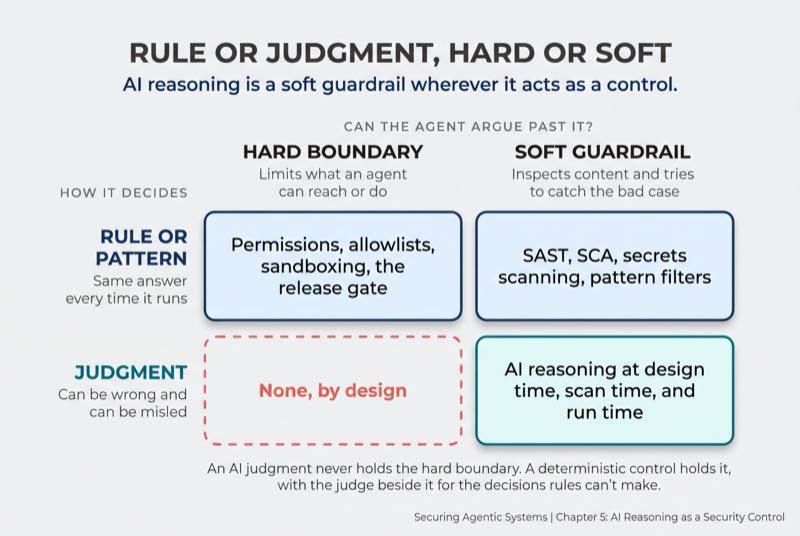
Rows show how a control decides. Columns show whether anything the agent says can argue its way past it. An AI judgment never holds the hard boundary, and the cell that reads none is the pairing rule.
A content classifier, a smaller model taught from examples to spot one kind of content, belongs in the rule-or-pattern row, beside the pattern filters, the keyword and regular-expression checks. It inspects content for the patterns it learned, so it's a soft guardrail. It isn't AI reasoning, because it doesn't judge against intent and policy. Anthropic calls its auto-mode judge a classifier, but it's a language model judging the agent's actions against the user's request and the rules it was given, so it sits in the judgment row. The split between the two rows is mine. ATLAS lists classifiers and LLM judges together as AI-based techniques.
Classifiers like these are fast, but attackers can get around them. In 2025, Hackett and colleagues evaded six systems that detect prompt injection and jailbreaks (the prompts that trick a model into ignoring its safety rules) and reported "in some instances up to 100% evasion success." That result is a point in time, and the vendors may have patched since. LLM-based checks are slower. In a content-moderation benchmark published by the vendor TrueFoundry, an LLM-based service answered in about 1.1 seconds and Azure's content-safety service in about 52 milliseconds, roughly 20 times faster. Neither kind of check can hold the boundary, which is why the two-tier gate puts a deterministic tier first and a judge behind it for what rules can't decide.
Anthropic's auto mode, the judge from the first section, ships in that order. Its documentation puts the user's own permission rules first. "Deny and explicit ask rules are evaluated before the classifier and still block or prompt." Running rules first also keeps the slower judge off every request those rules settle. The same page also says the classifier is what blocks "anything irreversible, destructive, or aimed outside your environment," so unless your deny rules or a sandbox already stop those actions, auto mode puts the judge where the pairing rule says it never stands.
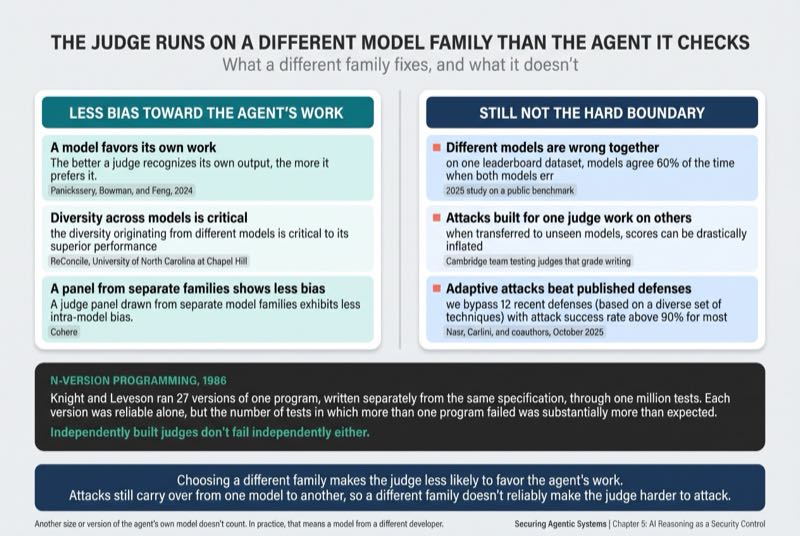
The Judge Runs on a Different Model Family
Wherever AI reasoning runs, the judge runs on a different model family than the agent it checks. Another size or version of the agent's own model doesn't count. In practice, that means a model from a different developer. By this rule, auto mode's judge doesn't qualify on its own, because a Claude model checks a Claude agent. Its reasoning-blind design still helps beside a judge from a different family. Read together, the two findings say what auto mode needs from you. Deny rules or a sandbox stop the irreversible actions, and a judge from another family sits beside its own.
A model favors its own work. Panickssery, Bowman, and Feng found in 2024 "a linear correlation between self-recognition capability and the strength of self-preference bias," so the better a judge recognizes its own output, the more it prefers it. A 2025 study of model similarity put it more broadly. "LLM-as-a-judge scores favor models similar to the judge, generalizing recent self-preference results."
A draft of this definition ended by saying AI reasoning never serves as the hard boundary. I'd already published that rule, and I disagreed with it. I thought independent agents on different models could act as that boundary. I remembered MIT research on agents judging agents, where the critical component was having them come from different models, and I went looking for the paper. My memory was close but not exact.
The MIT paper, by Du and colleagues in 2023, ran its debates mostly between copies of one model. Its two-model result was a side test on 20 grade-school math problems, where one model alone solved 11, the other 14, and the two in debate 17. The "critical" finding is from ReConcile, a study at the University of North Carolina at Chapel Hill, which reports that "the diversity originating from different models is critical to its superior performance." Researchers at the AI company Cohere found that a judge panel drawn from separate model families "exhibits less intra-model bias," the bias a judge shows toward its own model family.
The same search turned up why a panel still can't be the boundary. Different models tend to be wrong together. One 2025 study, testing models on a public benchmark, found that "on one leaderboard dataset, models agree 60% of the time when both models err." The model-similarity study reported that "model mistakes are becoming more similar with increasing capabilities, pointing to risks from correlated failures."
Attacks built for one judge work on others. A Cambridge team testing judges that grade writing found that "when transferred to unseen models, scores can be drastically inflated." Defenses against jailbreaks and prompt injection also fail when the attacker adapts. In October 2025 Nasr, Carlini, and their coauthors tuned an attack to each defense they tested. They wrote, "we bypass 12 recent defenses (based on a diverse set of techniques) with attack success rate above 90% for most." I kept the pairing rule.
Software engineers saw correlated failures forty years ago with N-version programming. Several teams write the same program independently so that one failure won't take the system down. In 1986 John Knight and Nancy Leveson ran 27 versions of one program, written separately from the same specification at two universities, through one million tests. Each version was reliable alone, but "the number of tests in which more than one program failed was substantially more than expected." Independently built judges don't fail independently either.
Choosing a different family makes the judge less likely to favor the agent's work. Attacks still carry over from one model to another, so a different family doesn't reliably make the judge harder to attack.
How Measure Scores It
No judge can hold the boundary, so the scoring can't let a judge hide a missing one. In Measure, each of the seven posture domains on each system, such as agent identity, gets one verdict: implemented, partially implemented, or not implemented. A posture domain is one area of an agent's security, and Chapter 6 defines all seven. One domain on one system is a cell. The cell's verdict starts from its deterministic controls. Where a decision in that domain depends on intent, the cell can't score implemented without an AI reasoning control beside the hard boundary, and without the hard boundary it can't score above partially implemented however many judges it has. The hard boundary sets the ceiling, so a strong AI reasoning control can't hide the fact that a hard boundary is missing.
Soft guardrails alone score partially implemented at best, because the control that stops the action isn't there. If an agent can take an action that needs a hard boundary, such as moving money, and that boundary isn't there, no number of judges or filters raises the verdict. Chapter 12 names those actions, and Chapter 6 does the scoring.
After Chapter 6 sets up the seven domains, Chapters 7 through 13 apply both types of control one domain at a time. Design time returns in Chapters 24 and 30, scan time in Chapters 19 and 25, and run time in Chapters 12 and 28.
From Definition to Scoring
Most of the controls you run today are rule-based, and they pass whatever fits the rule. That includes the email your user didn't ask for and the code that's clean and does the wrong thing.
Your vendors and auditors will bring you a model-based check under whichever name they use. I give it one definition here, so the next eight chapters can score it inside the same verdict.
Two rules go with that definition everywhere in this book. With the question from the first section, they're the three things to ask any vendor. A deterministic control holds the hard boundary, and the judge runs on a different model family than the agent it checks.
This is Chapter 5 of Securing Agentic Systems. Chapter 6, The Seven Agentic Posture Domains, comes next.
A rule confirms your agent may send the email. The judge, running on a different model family, asks whether it's the one your user asked for. If the answer is no, a deterministic gate blocks it, and the domain list and the hourly cap bound whatever the judge misses.