From Objects to Agents: The Next Programming Paradigm Shift
You Learned OOP. Now It's Time to Learn AOD
When I was 6, I first learned to program Apple BASIC. My dad sat me down and showed me "Space Invaders," which he'd swapped at a local "Apple Users Group". To launch the game, you first had to load the disk catalog, then run the binary. He showed me how to write a simple startup program that let you select a game with the arrow keys and launch it automatically. It only shaved a half-second off load time, but I learned I could write my own applications. From there, I devoured Byte Magazine and wrote my own games to share with my classmates.
In high school, BASIC and Pascal were fine, but I wanted to be ready for college. I saved my money working at the local library and bought Borland C++. I tried to build my own application, but without a teacher, I knew I was missing the theory behind what I was doing. I didn't connect the dots until I wrote my first truly object-oriented application freshman year at UIUC. It was nothing more than simple examples of inheritance, polymorphism, and encapsulation, but it was far more elegant than the procedural programming of Apple BASIC in 10, 20, 30 order. (If you know, you know.)
Now, late into my 40s and after writing programs in more languages than I can remember, I sat down with Claude Code, and it reinvigorated my desire to build.
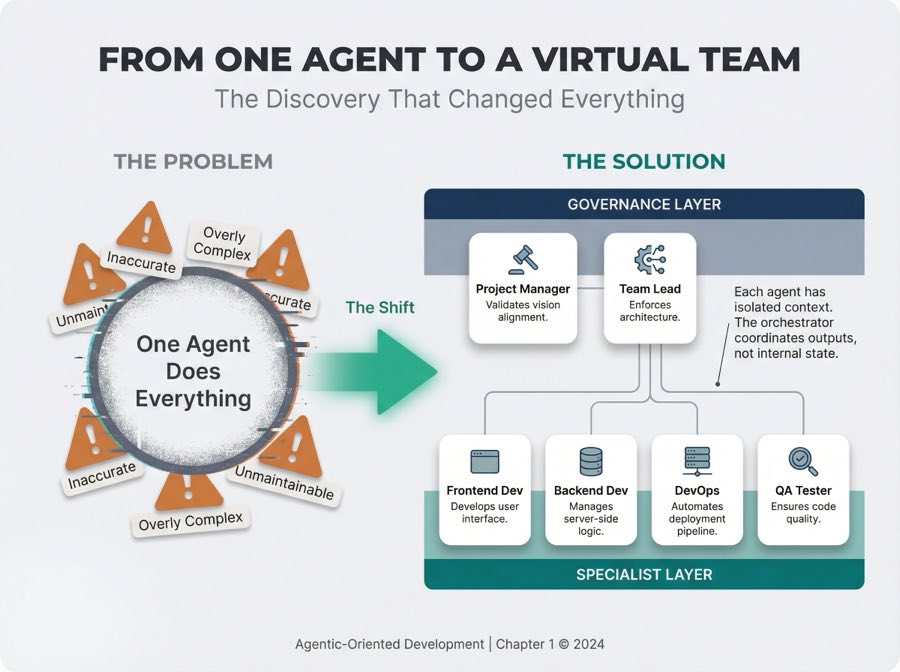
At first, the process was slow. The coding agent was inaccurate and would create overly complex code I couldn't maintain. But then, it clicked. I was trying to make one agent do everything. I put my "development leader" hat on and started building a virtual team. I spun up a Frontend Developer agent, a Backend Developer agent, a DevOps engineer, and a QA Tester.
Suddenly, I was creating better code, but there were still errors and poor technical choices. So, I introduced a "Team Lead" agent to enforce architecture and a "Project Manager" agent to keep the team aligned with the product vision.
I realized something: I was using all my old Object-Oriented tricks, encapsulation, abstraction, specialization, but in an Agentic way.
"We're in another paradigm shift. And most developers don't have the mental model for it yet."
Welcome to Agentic-Oriented Development (AOD).
The Paradigm Progression
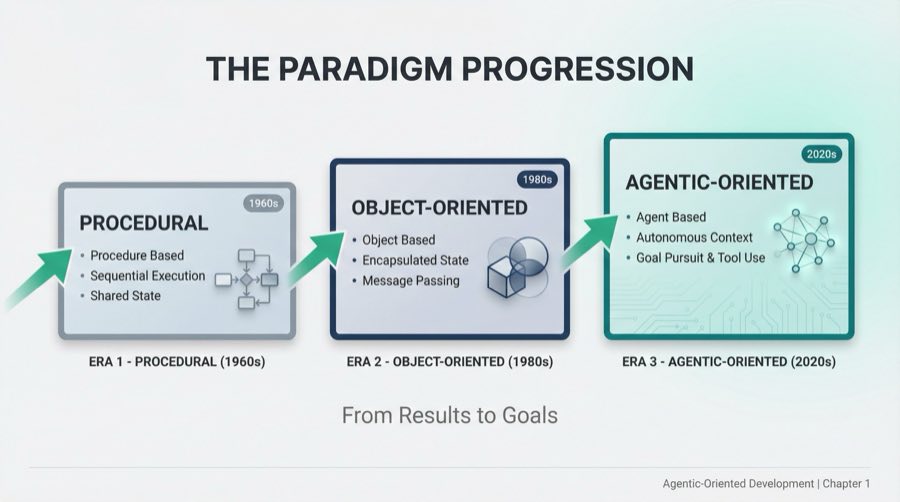
Every major programming paradigm is defined by its fundamental unit of organization:
- Procedural (1960s): Organize around procedures. Sequential execution, shared state.
- Object-Oriented (1980s): Organize around objects. Encapsulated state + behavior, message passing.
- Agentic-Oriented (2020s): Organize around agents. Autonomous context, goal pursuit, tool use, delegation.
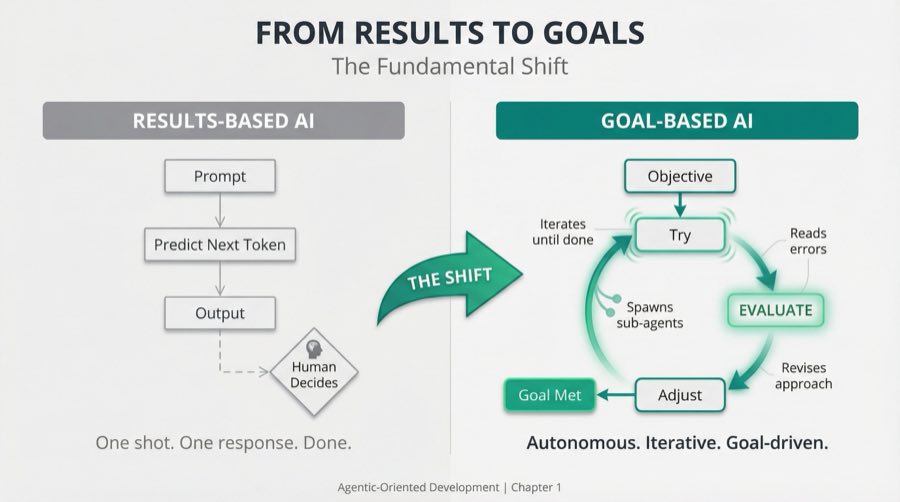
The shift is from results to goals. Earlier AI was result-based. It predicted the next token, gave you an output, and you decided if it was right or wrong. That was the end of the interaction. Today's coding agents are goal-based. Give Claude Code an objective, and it doesn't just generate a response. It tries, evaluates, adjusts, and iterates until the goal is met. It reads error messages, revises its approach, spawns sub-agents for parallel work, and keeps pushing forward. That's not a smarter prediction engine. That's a fundamentally different way of working.
The Four Pillars: OOP to AOD
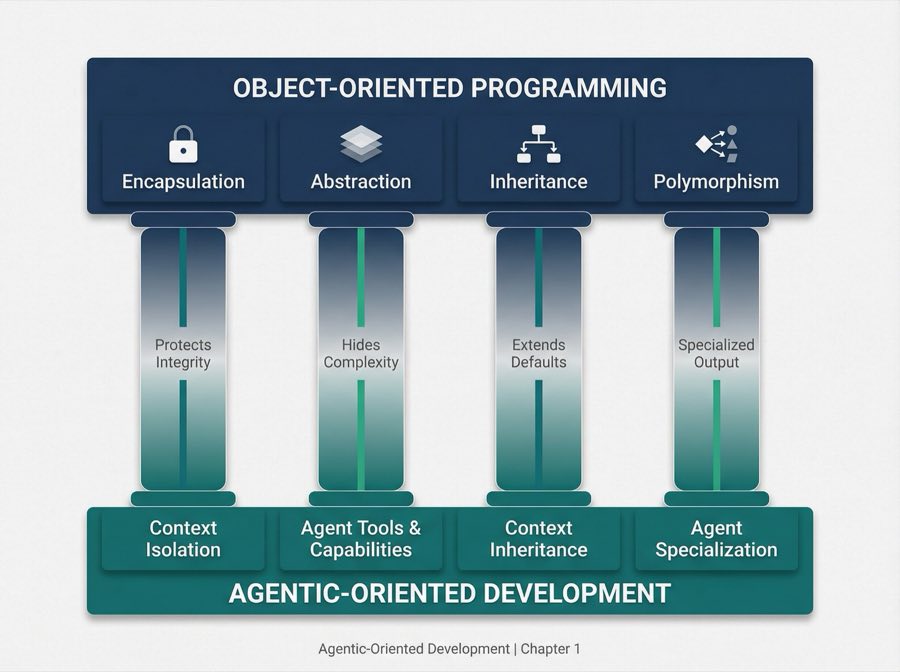
Here's what I've discovered: the principles that made OOP powerful map directly to working with coding agents.
Pillar 1: Encapsulation to Context Isolation
OOP Principle: Encapsulation binds data and behavior together, hiding internal state behind public interfaces. Private fields protect object integrity.
AOD Mapping: Each sub-agent operates with its own isolated context window. The orchestrating agent doesn't see the sub-agent's internal reasoning, only the results. This "context encapsulation" prevents pollution, where unrelated information degrades agent performance.
When you spawn a code-reviewer sub-agent, a test-writer sub-agent, and a documentation sub-agent in parallel, each maintains private context. The orchestrator coordinates their outputs without their internal states interfering with each other.
"Context windows ARE the new memory model. Protect them like you protect object state."
Pillar 2: Abstraction to Agent Tools & Capabilities
OOP Principle: Abstraction hides implementation complexity behind simple interfaces. You call a method without knowing its internals.
AOD Mapping: Tools are the new methods. Agents use tools to perform actions, reading files, running SQL, or pinging APIs, without needing to know how those systems work.
This is where protocols like MCP (Model Context Protocol) are critical. Just as OOP relies on standard interfaces (APIs), AOD relies on standard tool definitions. You give the agent a "GitHub Tool," and the complexity of the GitHub API is abstracted away. The agent simply "intends" to open a PR, and the tool handles the execution.
The best agent architectures hide their sophistication behind standard tool interfaces.
Pillar 3: Inheritance to Context Inheritance
OOP Principle: Child classes inherit state and behavior from parent classes. Specific implementations extend and override general ones.
AOD Mapping: Agent configurations follow the same pattern. A project agent inherits the "rules of the road" from global settings, just as a child class inherits from a parent class.
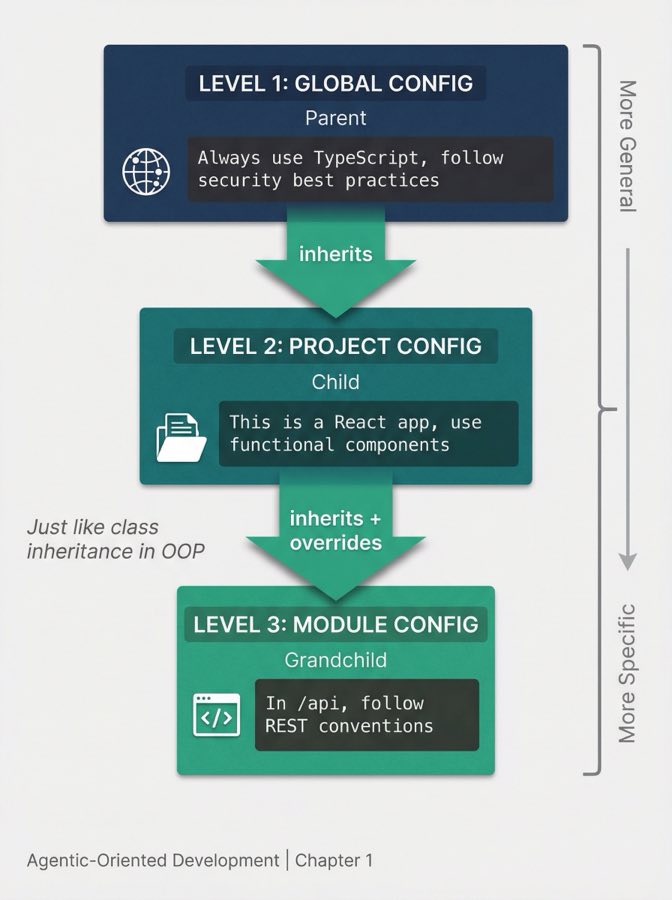
More specific contexts inherit from and override more general ones. Understanding this hierarchy transforms how you structure agent instructions.
"Your agents inherit context. Design the inheritance chain deliberately."
Pillar 4: Polymorphism to Agent Specialization
OOP Principle: Polymorphism means the same interface produces different behavior based on object type. Call animal.move() and get walking, flying, or swimming depending on the concrete class.
AOD Mapping: In agentic development, the prompt is the interface. You type plain English, and the system decides which specialized agent handles it. "Analyze this code" dispatches to a security-reviewer, performance-analyzer, or accessibility-auditor based on context.
Same input. Different specialized outputs. The interface (natural language) stays constant while the concrete implementation (which agent responds) varies at runtime.
Design your agent ecosystem for polymorphic delegation. One interface, many specialists.
Why This Matters Now
If you're using coding agents without this mental model, you're vibe coding. You're hoping the AI figures it out. Sometimes it works. Often it doesn't. And you have no framework for understanding why your agent lost context, produced inconsistent results, or couldn't scale beyond simple tasks.
Agentic-Oriented Development gives you that framework:
- Think in agents, not prompts
- Protect context like you protect object state
- Compose specialists rather than building monolithic super-agents
- Design inheritance chains for your configurations
- Build for polymorphic delegation across specialized agents
The developers who master these patterns won't just use AI to code. They'll architect how AI codes. They'll build agent workflows that are maintainable, testable, and scalable, the same qualities we demanded from OOP codebases.
Everyone else will keep vibe coding, wondering why their agents plateau while yours accelerate.
What's Next
This is the opening chapter of an ongoing series on Agentic-Oriented Development. Each chapter maps a familiar software engineering principle to the new world of agentic systems.
The series so far:
- Chapter 2: Context Windows Are the New Memory Management
- Chapter 3: Tools Are the New Methods
- Chapter 4: Designing Your Agent's Inheritance Chain
- Chapter 5: One Prompt, Many Specialists
- Chapter 6: From Prompt Engineer to Agentic Engineer
- Chapter 7: Process Mastery
Follow along in my newsletter, The Agentic Shift, where new chapters drop weekly.
What patterns are you discovering as you work with coding agents? Where does this framework resonate, or break down?
The paradigm is shifting. Don't get left behind!