The Paradigm Is Shifting
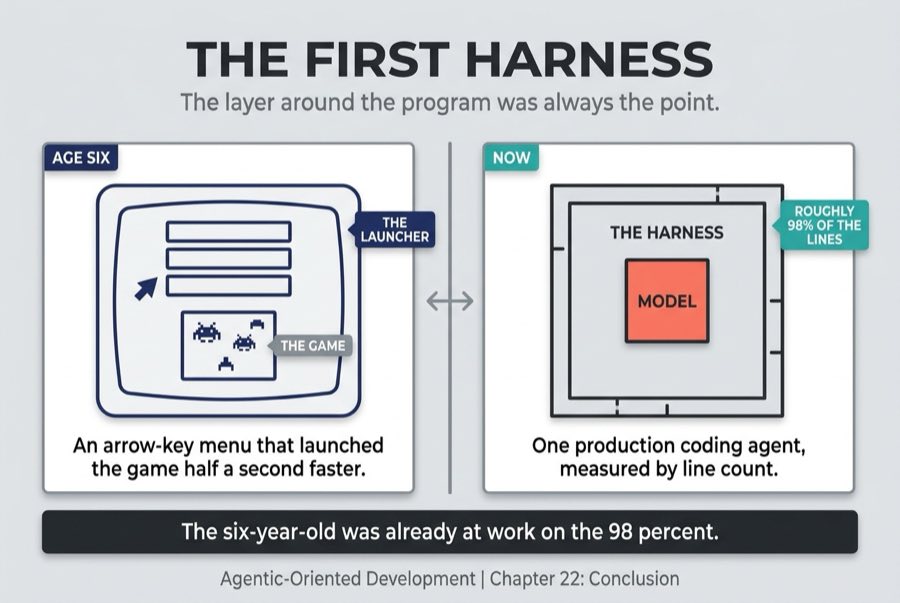
The first program I ever wrote did nothing by itself. I was six, my dad had just swapped a copy of Space Invaders at a local Apple Users Group, and launching a game meant loading the disk catalog and then running the binary. He showed me how to write a simple startup program instead, a menu that let you pick a game with the arrow keys and launch it automatically. It shaved half a second off load time, and it taught me that the layer around the program was something I could build.
When I later asked him to bring home more games and he came back with a magazine carrying a type-in listing for Asteroids, I typed the game in, saved it to disk, and built my own launcher to run it. He showed me how once. Every launcher after that was mine.
This book opened on that half-second, and it closes there. In Chapter 21 I cited a teardown that measured a production coding agent, by line count, at roughly 98 percent harness, the system somebody designed around the model rather than the model itself. The six-year-old with the arrow-key menu was already at work on the 98 percent. Agentic-Oriented Development (AOD) is that instinct matured into a discipline. This closing chapter is not a recap. It is one walk up the ladder you climbed to get here, naming what you hold at each rung.
One Climb, Not Twenty-Two Chapters
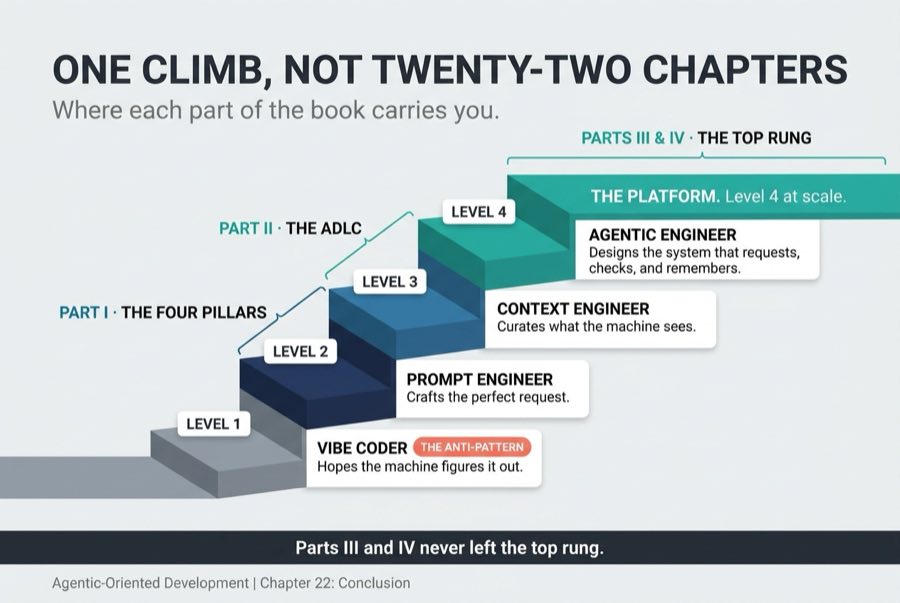
The argument of this book was never chapter-shaped. It is a ladder with four rungs, the Agentic Maturity Ladder from Chapter 6, and every part of the book exists to move you up it. Level 1 is the vibe coder, who hopes the machine figures it out. Level 2 is the prompt engineer, who crafts the perfect request and lives inside a single interaction. Level 3 is the context engineer, who curates what the machine sees before it reasons. Level 4 is the agentic engineer, who designs the system that does the requesting, the checking, and the remembering.
I have made that trade twice myself, from BASIC's numbered lines to objects at the University of Illinois, then from objects to agents late into my 40s, each time giving up a smaller unit of organization for a larger one. The book asked that trade of you twice. Part I carried you from prompt engineer to context engineer. Part II carried you from context engineer to agentic engineer. Parts III and IV never left that top rung.
If the climb worked, you no longer think in prompts. You think in systems that prompt.
The Pillars Got You Off the Ground
Context engineering changed where you spend attention. A prompt engineer polishes the request. A context engineer manages what the machine sees while it works. Part I turned that management into four pillars, and each one is a possession now.
You protect an agent's working memory from pollution and exhaustion, delegating focused work into isolated sub-agent windows so one task's noise never bleeds into another's reasoning. Object-oriented programmers aimed the same protective instinct at object state and called it encapsulation.
You hand an agent capability with the complexity hidden, tools designed under the VOICE principles so each one stays visible, outcome-oriented, isolated, composable, and error-aware. The Model Context Protocol (MCP) became the shared socket those tools plug into. Your base configuration stays lean, under 200 lines, with specialized context loading only when the work calls for it, the way a child class extended a parent. And you let one plain-English prompt dispatch to many specialists rather than feeding every rule to one Swiss Army Agent that optimizes for everything and excels at nothing.
The pillars were never about class syntax. They were about managing complexity under a scarce resource. In the object era the scarce resources were memory and processor time. In the agent era they are attention and context. The substrate changed underneath the principles, and the principles held. That survival is the reason a book like this one could be written at all.
The Governance Triad, the project manager, architect, and team lead agents that keep a virtual team aligned, entered the book in Chapter 2, before a single architecture diagram did. Hold on to that timing.
The Lifecycle Made You an Engineer
Context discipline is necessary, and it is static. It shapes what the machine sees, not what happens next. Agentic engineering is dynamic. You stop doing the work and start designing the system that does the work, and five skills carry you across that line.
Process Mastery designs the workflow before the prompt, and every other skill depends on that order of operations. Orchestration coordinates a team of specialists instead of overloading one model with every concern. Evals and Loops make your quality criteria executable, scoring each attempt and looping until the work passes. Test-Driven Development (TDD) makes tests the specification, written before the code so the agent builds toward them rather than past them. And Knowledge Engineering serializes what a session learned into artifacts the next session can load, so tomorrow's agent starts sighted.
The five skills run inside one lifecycle. The Agentic Development Lifecycle (ADLC) collapses the two lifecycles we used to run in parallel, one for the product and one for the software, into six stages, Discover through Document. The shape matters more than the stage names. Document feeds Discover, the lifecycle closes into a circle, and without that closure every new session pays the context reconstruction tax, re-learning what the last session already knew.
One governed revolution of that circle, scoped to a single issue, is the Loop, AOD's unit of execution. Sprints were time-boxed to spread the cost of human coordination. Loops are scope-boxed because coding agents collapse that cost.
If Part II left one insight in your hands, it is that evals became control flow, and eval design became system design. The quality bar you write decides what the system does next, which makes writing the quality bar the engineering. AURA (Agentic Utilization and Reliability Assessment) closes the climb with five metrics that give coding agents the kind of scoreboard DevOps has had for a decade, because a practice you cannot measure is a practice you cannot defend.
The Top of the Ladder Is a Platform
Nothing above agentic engineering is a new level. The industry keeps minting candidate rungs, harness engineering one season and loop engineering the next, and Chapter 21 placed both where they belong, as components of agentic engineering rather than promotions above it. The ladder tops out. Above the last rung you do not gain altitude. You gain surface area to build on.
At system scale, you hold the anatomy and the arrangement. The Agent Stack wraps the model in the layers you design, and Chapter 14 bound that anatomy into a single sentence. "The whole system around the model binds scaffold, tools, memory, loop engine, and gates into one working agent." The topology arranges many such agents, user to orchestrator to agents to capabilities, the class diagram of the new paradigm. Two protocols wire it together. MCP reaches down from an agent to its tools, and Agent-to-Agent (A2A) reaches across to its peers.
Four design patterns carried over from the object era earn their keep in the new material. The factory makes agent creation a contract instead of an accident. The facade puts one face over the whole topology so callers never learn its shape. Swappable behaviors let the orchestrator pick its specialist at runtime instead of hard-wiring the choice. The escalation chain walks failure upward, handler by handler, until a human answers.
At organizational scale, you hold the failure catalog and the adoption playbook. The six anti-patterns share one root, expecting deterministic behavior from a probabilistic machine, and each one marks the absence of a positive pattern you now practice. Enterprise adoption turned out to be an evidence problem, and the lifecycle you run produces that evidence as a byproduct rather than as extra work. You can sort the harness landscape into four categories and split governance into three flavors.
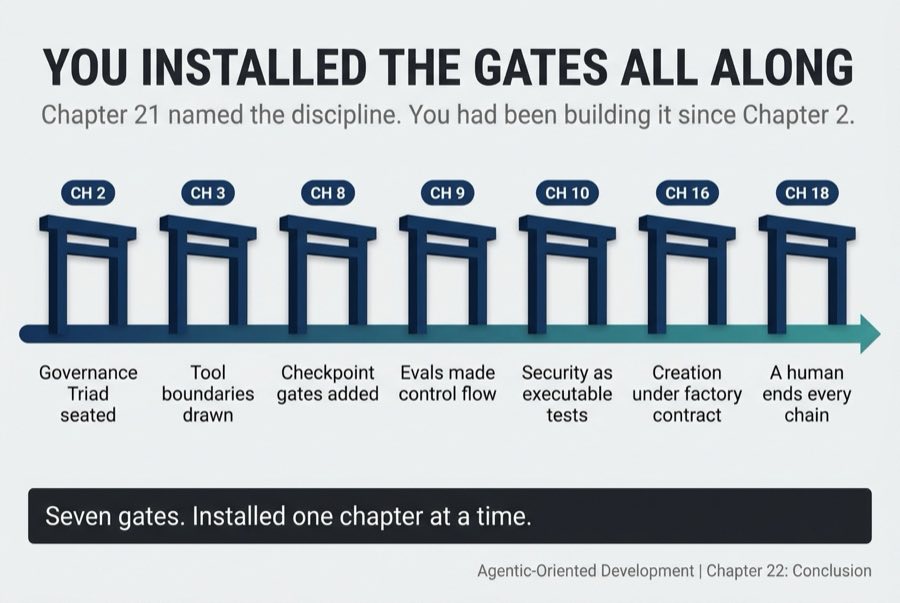
Chapter 21 closed on the observation that spinning up a loop is cheap now and the gates remain the work. But the gates did not arrive in Chapter 21. You installed them all along. You seated the Governance Triad in Chapter 2, before there was any architecture to govern. You drew tool boundaries in Chapter 3. You added checkpoint gates in Chapter 8, made evals the control flow in Chapter 9, wrote security requirements as executable tests in Chapter 10, put agent creation under a factory contract in Chapter 16, and made a human the end of every escalation chain in Chapter 18. Chapter 21 did not teach you gate discipline. It named the discipline you had been practicing since the second chapter of this book.
The Map
Every framework in this book nests into one map:
- The Four Pillars - the mental model you think with
- The Agentic Maturity Ladder - the climb you made
- The Five Skills, the ADLC, and the Loop - the practice you run
- The Agent Stack and the Topology - the architecture you build
- Governance - the thread that runs through all four, not a fifth box
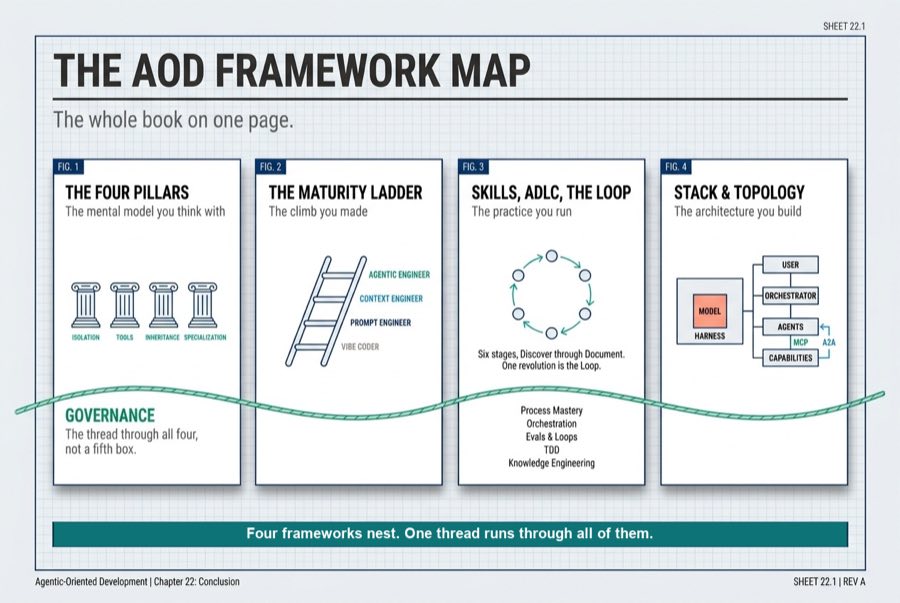
That is the whole book on one page. When the chapter details fade, and they will, the map is what should remain.
The Opportunity
An early grasp of objects was an inheritance. The frameworks, the architectures, and a good number of the defining careers of the last thirty years were built on that early fluency. The same window is open for agents right now, and the disciplines in this book are still differentiators. Table stakes is the destiny of every practice that works.
I watched this window begin to open from the inside. I was an early adopter of GitHub Copilot, back when I could type a function name and poof, the whole function appeared, like spellcheck for coding. Completion hinted at the shift. Agents are the shift.
The practice is concrete enough to start tomorrow. An AOD practitioner writes the spec before the prompt, gives every agent one domain and a gate, and serializes what the session learned before closing it. None of that depends on a vendor. All of it runs the same on Claude Code, Cursor, Windsurf, or Copilot, because the principles live a layer above the products.
The industry will rename its frontier again. Prompt engineering gave way to context engineering, then harness engineering, then loop engineering, and the next name will claim to contain them all. Let it. The pillars and the gates transfer. The developers who internalized objects defined the last era of software. The developers who internalize agents will define the next one.
Where the Arc Lands
Decades after that arrow-key menu, with more languages behind me than I can remember, I went a full year without writing code. The last things I had built were iOS apps. Then Claude Code kept popping up, and at the same moment an email arrived from Udemy about a $10 Claude Code course, taught by an instructor whose system design classes I had already taken. That $10 changed everything.
In a few hours I had written my first web app connected to an API. Soon after that, I repointed an old iOS stock monitoring app to an entirely new data service in under an hour.
And then I did what the six-year-old had done, at the scale an adult could attempt. I learned harnesses by building my own. I learned security by building my own threat modeling application. And the whole time I kept building a personal knowledge base, so nothing a session taught me died with its context. I had lived this book's spine before I wrote a word of it, understanding the system, governing what it built, and keeping what it learned.
This isn't an end. This is the beginning of a whole new way to interact with computers. Is it clunky? Yes. But so was typing in assembly on punch cards.
The conviction that started this book is the one that closes it. You cannot secure a system you do not understand, and the understanding is now yours. Everything that gets built on top of it, the securing and the governing, comes next.
At six, I thought the game was the point and the launcher was the chore. It took the rest of my career to learn it was the other way around.
What's Next
This is the final chapter of Agentic-Oriented Development. The complete book is free to read online, and the work continues in my newsletter, The Agentic Shift. Security is where that work turns next.
About the Author: David Matousek is the author of Agentic-Oriented Development, available to read in full at agentic-oriented-development.com, and Securing Agentic Systems, serializing weekly in The Agentic Shift. He shares practical insights on agentic development and enterprise risk from a career leading security, risk, and compliance architecture for large-scale enterprise systems, and maintains AOD-Kit, an open-source toolkit for agentic-oriented development, and tachi, an open-source agentic threat modeling tool that puts AOD principles into practice. Connect with him on LinkedIn to compare notes, share your experiences, or visit davidmatousek.com to explore how these principles apply to your organization.